Wednesday, 27 January 2016

I've moved!

My blog has now moved to davidwindsorblog.wordpress.com. Hope to see you there!

Thursday, 21 January 2016

Review of Fenix 3 Watch

I'd thought of buying an Apple Watch for some time before getting this instead. I work in an environment where getting your phone out to check emails, messages etc is frowned upon so this seemed a more discreet way of staying connected. I also like the idea of using a watch for basic navigation in the hills (see my previous post on my Casio).
But, although I am heavily committed to Apple, the watch didn't seem to be what I wanted. It doesn't have in-built gps, so you need to keep your phone with you at all times. It doesn't have its own app for fitness and tracking - you have to use third party apps like Strava, Runkeeper, Edmondo etc. And it isn't waterproof, so I'd worry about constantly checking it in a Highland downpour. The battery life is poor, compared to what I eventually bought. It does have a Viewranger app, but this wasn't enough to sway me.


A comparison of the screens of Fenix 3 and 2

So after a quick trial of the Fenix 2, which I sent back after a few days as the notifications drained the battery very quickly and the screen was nowhere near as good, I settled on the Fenix 3. I use it to record any walks, runs or bike rides I do. These are then automatically uploaded to Garmin's Connect website with routes, speed, ascent, pace amongst the information available. Routes can be exported from there, so I can import the routes into Viewranger and view them on a decent map.
The screen is excellent in sunlight, however bright. But from twilight onwards it's less easy to see. There is a backlight though, which can be configured to come on automatically.
I've yet to experiment with importing routes to the watch and then following them. There are simpler functions you can do directly from the watch, for example re-tracing your route, having directions to your starting point or any other point you record. I left a rucksack on a pathless slope to complete the summit and recorded its position as a waypoint.On my return I selected navigate to waypoint and the watch showed me the direction, distance and how long it would take to get there; all while continuing to record the whole route. It was very accurate.
Although the forums were, until the latest update, full of people complaining about gps inaccuracy I've yet to have a problem. Updates are frequent and continue to add functionality to the device: the most recent added new apps (activities you can record) such as indoor rowing, widgets (data screens you can access at any time), as well as automatic sleep tracking.
Notifications match those on your phone, so anything you have set up as a notification will appear on the watch screen. This is very useful as you can decide whether or not it's worth getting your phone out.
You can get further watch faces, apps, widgets and data screens from Garmin's Connect IQ store. I've tried a few watch faces out but none of them seem as good as the ones done by Garmin. I don't find any analogue watch face to be as good as the digital ones - why would you use a digital watch to copy, in rather a bad way, what analogue watches do?
I've worn this watch on every walk/run/bike ride/visit to the gym for the last 6 months and it looks as good as new. Battery life depends upon how many activities with GPS you record. I charge mine up every week, having used it for perhaps 5 or 6 hours of recording.
So far, I'm really pleased with the watch. There's still a lot I haven't tried out: following routes, pairing it to a heart rate monitor etc and the configurations of data screens within activities are endless and I haven't played with these much.
I'll finish with some pictures to give you a better idea of how apps, widgets and data screens look.


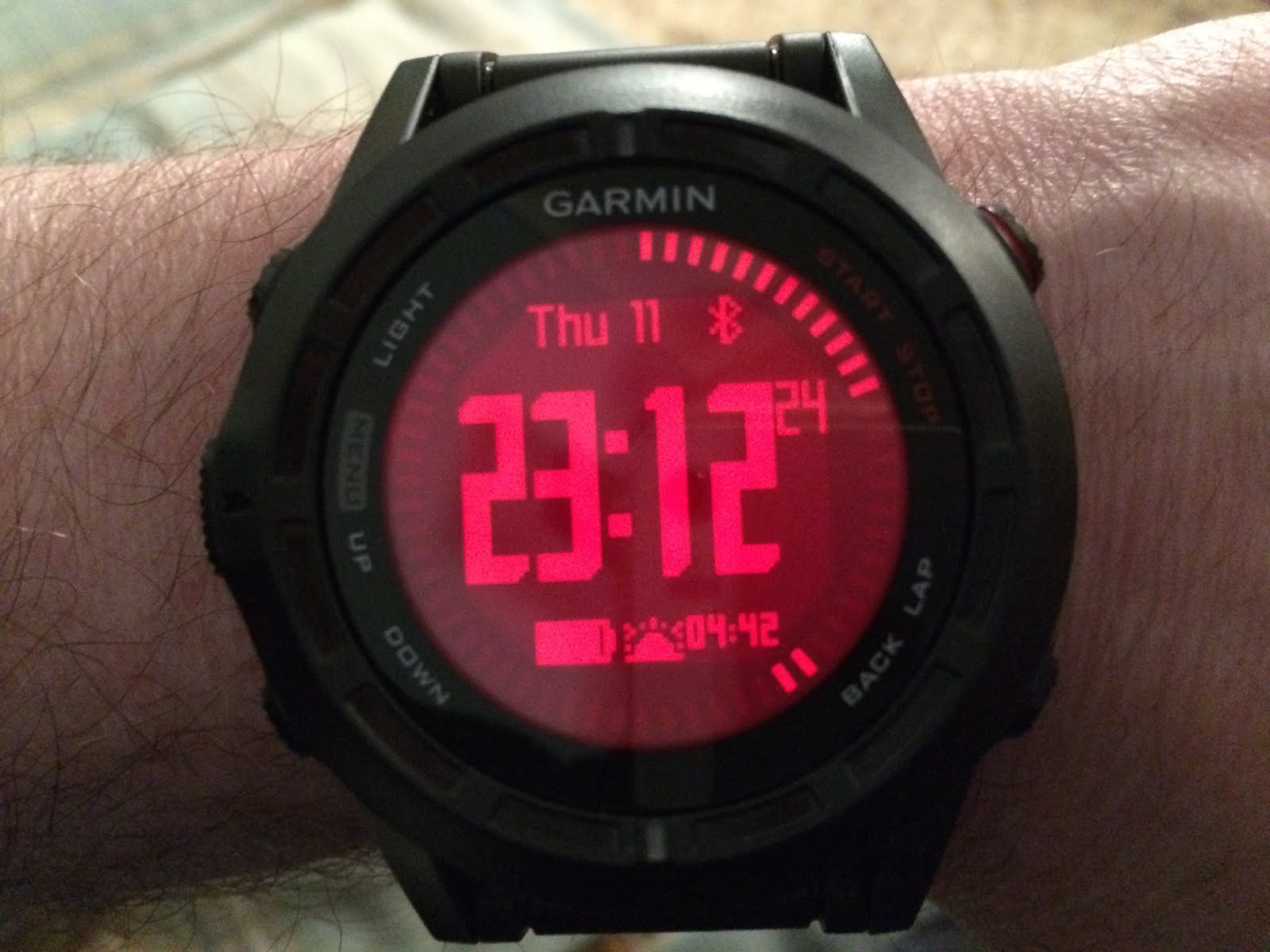
My current watch face
An email arriving


The activity widget, showing steps goal, total steps, distance, flights of stairs climbed and the red inactivity bar


That's an all-day event, I wasn't doing this in a staff meeting!


Walking app started, finding gps


Still here

A Slight Delay

It’s been 3 years since I last blogged in a personal capacity. My last posts dealt with donating a kidney and since then I’ve been trying to get back the energy I used to have to get my job done and still find time for other things.

The stages in this were:

  • get used to working again
  • get fit again
  • get back to being able to read without falling asleep

I’ve managed to do all those at last. What set me back was having to go through two further operations for three hernias, which arose as a result of the initial operation. I’ll post about these later on. But for now I think I’ll just post something different as I feel it may be unhealthy and tedious to write too much about health!

I’ll do future posts on hillwalking, Scotland, books and music (although that’s the day job and I aim to do something different).

So, while I’m preparing quick reviews of what I’ve read over the past two years, here’s a review of my latest toy, sorry, vital navigational equipment.

Thursday, 23 May 2013

Kidney donation: back at home


OK, the final part of my adventures with kidney donation. After this I’ll shut up about it and get back to books, music and hills.
I arrived home. It felt colder than normal, not just because the first of many snowfalls was icing the moor. My lie about constipation ending became true, less than an hour after taking some Ducalease. That, and the stomach ache it caused, was never a problem again. After some real (as opposed to hospital) food I was ready for bed. I tried to sleep in my normal bed. However, it wasn’t adjustable so I had to lie flat and just couldn’t stretch out at all, it seemed that lying flat was stretching the wound too much. Neither could I sleep for long on either side, the pain from my stomach muscles was too much. Indeed, lying on my left side gave me a feeling that my insides were falling. I slept for an hour or so on my right, with my knees tucked up to stop my stomach stretching. Then I decided to get up. It took ages and was very painful. Luckily we have a reclining chair and for the next few weeks I slept in that. Sleep wasn’t a problem after that as I could sleep at an angle which didn’t stretch my stomach and the chair arms stopped me from turning on my side.
I had been told not to do anything, not even the dishes - it sounds ridiculous but when I tried a week or so later, stretching to put plates in cupboards hurt! But I felt that I needed to improve gradually.
Five days later I walked to the end of the drive. 

Again, it sounds ridiculous. I’d walked as much as I could in hospital but snow was everywhere outside and if I fell I wasn’t sure I’d be able to get up again. Still, it felt good to be out. For these first few days, all I could do most of the time was sit and sleep. At certain times I would try to stand up and wander about downstairs.
My son came home the following weekend. He seemed fine, his old colour and energy slowly returning. We spent the next few days together but his recovery was quicker than mine and he was able to drive and get about quite quickly. We didn’t talk much about what happened, I’m not sure we have even now. Firstly, neither of us talk very much. Secondly, what had happened was almost too serious for conversation. And thirdly, I hope, we didn’t need to talk about it: we knew.
For six weeks I visited the North Staffs hospital every Friday. Both Birmingham and North Staffs hospitals are new buildings. Birmingham is much bigger and cleaner and seems better equipped. North Staffs manages to smell, strange for a new building, and often had dirty floors. The entrance to North Staffs is crowded with smokers, both patients and visitors. Is the council seriously building smoking shelters? North Staffs staff are friendlier and more caring. Those were my impressions anyway.
After a few more days I tried a walk “around the block”. For those of you who know Biddulph Moor this is up Rudyard Road, along Top Road, down Leek Lane and back. For those of you who don’t, it’s about 2 miles, with some of the finest views in England. It only involved a 100 feet or so of ascent but it was very tiring, I could only walk bent over. The walk took a long time but at least I had done it and it was another step forward. I slept for hours the moment I got back.
So I gradually established a routine of a quick stroll, sleep, try to do something like read or work, sleep. Trying to do something almost always failed. Faced with 6 weeks off work I had all sorts of ideas - read lots of books, prepare some great resources for teaching, get used to my new laptop. None of this happened, I simply didn’t have the energy. I could just about reply to texts and emails in the morning. All I did apart from that was watch tv. That would be enough to make anyone ill but luckily, my dad brought me a boxed set of the Sopranos, so I watched all six and a half series.
I tried a longer walk, from Baslow to Bakewell via Chatsworth. It was going quite well, although any ascent made me get out of breath. But descending a muddy path through some woods I slipped, only a foot or so. This opened my wound a little so I had to go back to doing very little and seeing a nurse 3 times a week to stuff the newly-formed hole - an inch wide and an inch deep - with seaweed. It was somehow distressing to see red, shiny flesh and liquid oozing out. It set me back and made me feel more tired.
I was surrounded by caring people supporting me. Firstly my wonderful wife, running rings around me, doing everything for me, never complaining. My parents, always there. Teachers at school emailing and texting, offering books and dvds, pupils emailing me their work and saying hurry up back but make sure you’re better first. Friends near and far emailing and texting. Almost everyone I knew helped me to recover.
About a month after the operation I was able to drive again. Turning around to see while reversing might have hurt my stomach, but I always use the mirrors instead anyway! At this point I still needed to sleep for 3 or 4 hours during the day. I was able to walk upright and on uneven ground.
I returned to work after 6 weeks. My school was kind enough to suggest a phased return, so I taught older, examination classes and avoided the younger, more boisterous ones. All students were kind, thoughtful, supportive and helpful. I did 2 weeks full time and then it was Easter. Now I’m back to my usual routine, cycling to work as normal.
Most people ask 2 things: would you do it again? Yes, for a close family member it’s a simple choice to make. Did it hurt? This needs a longer answer:
  • the cystoscopy was agonising for a short time, but not everyone will need this test
  • the lack of a kidney does not hurt, I don’t feel any different
  • after the operation I had pain through constipation and a soreness in the main wound
  • the leakage of the wound didn’t hurt
  • from the operation onwards I had pain in my stomach muscles. This culminated in a day of feeling as if I had “pulled” them all, fairly severe pain. This disappeared, but I still have a small amount of muscle pain, so I haven’t tried running yet, as I think this would jiggle the muscles up and down too much.
On the 9th of April, my son’s birthday, we were in Scotland, climbing A’Chralaig. Any route out of Glen Shiel is steep but short. I took my time, my son was far ahead of me, as he used to be. In time, delayed by snowfields, we reached the summit. Gusts of wind blew snow over us but the sun shone. It was clear. We could see hills we had completed and plenty that we still need to climb. It’s not often that life is as simple as hillwalking, but for once it was.

Wednesday, 1 May 2013

Kidney donation: in hospital


This is the 3rd part of 4 on my experiences of donating a kidney, posted here hoping that it will be of interest to anyone put in a similar position. The 4th part will deal with what happened after I left hospital and I’ll try to do an additional post on questions I’ve been asked.
I was admitted to Queen Elizabeth hospital (Birmingham) on a Wednesday evening and left the following Sunday evening. Before checking that the ward had a bed for me I did several tests as part of someone’s PhD thesis. He told me that he wanted to test the heart condition of donors before and after the operation as he said that although donors tended to live longer than average, because the tests they went through before being allowed to donate showed them to be healthier than average, nevertheless, some donors experienced a higher rate of heart problems. I thought it was a good idea to have a thorough series of heart tests before and after the operation, so I agreed to the research. After a couple of hours the doctor decided my heart was good and I was very fit for my age. The week before, a doctor had said that I would be fine as I was “among the fittest 5% of the population”. No, not fit like that. I’m no Olympic athlete either: I think she meant “healthiest” and I’ve certainly always been very lucky with my health.
We were told that our beds would be ready by about 9pm so we went to the pub for a drink and meal. It was a boisterous student pub, “The Gun Barrels” - friendly and with cheap food and drinks. Back at the hospital we were both given single rooms, ensuite no less. I felt no particular worry about what was going to happen, other than that the transplant had better be successful! I went through various tests - , temperature, blood, urine, blood pressure, swabs - before settling down for a good sleep.
I was woken to have more tests. The anaesthetist came to tell me what he was going to do. He seemed very nice and reassuring. The surgeon came to tell me what he was going to do. He was just as impressive, although it made me laugh that he used a marker pen to draw an arrow on me, pointing to the kidney which was to be removed. I didn’t see my son before the operation. He says he saw me as I was coming round, when he was being taken in. I was taken to the theatre, some nice conversation with the anaesthetist again, a mask and then nothing. Absolutely nothing. I think when you’re asleep, there is always some glimmer of consciousness or dreaming but this was nothingness - is that what death is like?
I was woken up and felt normal. No pain but obviously incapacitated. Attached to me were various things for holding electrodes (I forgot about some of these and found them at home, once I could move properly), a catheter, a line into the wound area for painkilling. The coil for this was sewn to my stomach. I also had a saline drip, morphine drip and oxygen tube thing that inserts into your nose. And I had been shaved from my belly button downwards. Oh the fun they must have had! I was shown how to press the button to get morphine. I used it once, later in the day, and fell asleep. Other than that, apart from once, I felt no need for extra painkillers. I was told, and had read online, that I should breathe deeply as soon as I came round, as this would prevent any chest infection/pneumonia. I did this, it didn’t cause much pain at all and I avoided any infection.
Once I’d come round properly I was taken up to another ward, for 4 people. I realised only then that I had left my laptop, phone, tablet, wallet, clothes all unlocked in the other room. But it was fine, everything had been moved to my new ward, it was all there. I just couldn’t reach them. I managed to stretch and get my phone and send a couple of texts, it took a ridiculous amount of effort. I kept falling asleep. I couldn’t stretch or hold the phone for long, or see what I was texting. 
I eventually came round again, a young man, visiting his father opposite me had donated his kidney a couple of days before. He told me what to expect, gave me lots of encouragement, saying such things as “you’ve done a great thing”. Strange considering he had just done exactly the same thing for his father. My time in hospital was made much better by the people on the ward. Opposite was Afraz. He kept us awake at night by hiccuping constantly, but that was hardly his fault. He had great dignity. And when my son eventually joined our ward he walked to the Costa at the front of the hospital (2 floors down and maybe a quarter of a mile away), in spite of having just had a transplant, to buy my son a croissant. Next to him was Glenroy, a bouncer/boxer/security guard, with the most wonderful combination of West Indian and Birmingham accents. His positive attitude, laughter and “Good morning Mr Windsor” every time I woke was joyful, life-affirming. Next to me was Phil, who by some coincidence came from where I do (Sneyd Green, Stoke-on-Trent) and supported the team I used to (Port Vale). Phil had been given the opportunity of a transplant when someone else refused one. His kidney function had been 11%, 10% is the threshold for dialysis, so the transplant had worked miracles on him. He was full of positive “no painkillers for me thank you, I feel wonderful. I don’t want that stupid wheelchair” comments, showing me that if the transplant worked, my son would be much better.
At this point my son was having his operation. We were to be kept separate at first, in case the poor condition of either of us affected the other. Besides, he would need more intensive care than me at first. Visiting time was from 2.30 till 7.30 and my wife soon came to see me. Up till this point I think the main part of dealing with this, the mental preparation, was something I just needed to do for myself. But after the operation it was the care of my wife and family that kept me going. Having someone to visit me, something to get ready for, people to talk to. She said I looked green on the first day. I’ve no idea what I looked like. It must have been torture for her to see both her husband and son go into surgery with all the risks involved, in a strange way I had it easier.
The hospital day starts at 6.30 - imagine being woken up by a lugubrious chap saying “can I do your bloods please?”. Tests, breakfast, more tests, a visit from the doctor, lunch, visiting time from 2.30 till 7.30, evening meal, more tests. Any urine I passed was at first measured via my catheter bag and then by me having to do all my wee in cardboard tubes and storing them under my bed. I had books with me but had no energy to read, I tried my best to keep up with people online but it took a lot of effort.
I was told I had to get up and get moving as soon as possible. The day after the operation I still had on the hospital dress I had for the operation. It wasn’t exactly fresh and had blood on it. I decided to have a shower. This resulted in a ridiculously long and painful session. Trying to get out of bed took what seemed like at least half an hour. My stomach muscles just couldn’t take lifting myself up. I eventually rolled onto my side as much as I could without falling off the edge of the bed and then pushed myself up. Very painful but the more I did it the easier it got. Once up I then had to walk to the shower. Trying to arrange the various tubes attached to me so that I could walk and taking the stupid pole they were all attached to wherever I went felt awful. But I had that shower and felt cleaner. I put a new dress on.
I had a plan and the determination to carry it out: to see if my son was ok (I was told that he was but that wasn’t enough) and to get out of hospital as soon as possible. I would do it in this order: get as many tubes as possible detached, wear my own clothes, walk as much as possible, including to my son’s ward. I asked a student nurse to remove my catheter, she checked with someone and then did. I asked the PhD student if I could have the painkiller feeds and the drip removed. It all seemed to go to plan and I’m not sure it would have happened so quickly if I hadn’t asked. Within a few hours I was free of that stupid pole and walking about my own ward. I couldn’t stretch enough to stand up straight and was walking around like a drunk Frankenstein, but I was walking. I asked where my son was and set off for his ward. I found him, having his back washed (no such luxury for us donors!). He seemed ill but stable. He hadn’t tried to get up. Perhaps being younger he hadn’t felt that he should ask to be detached from various tubes. He was surprised to see me up and I think that encouraged him to try for himself, which he did later in the day. Which led to us both trawling the corridors in some sort of zombie ballet. Seeing him cheered me up a lot, knowing that it had been successful and a worthwhile thing to do.
At no point did I feel any pain from my lack of kidney. The pain I felt was from the main wound (the kind of pain you would expect from a cut - stinging soreness), very weak stomach muscles and constipation. From Friday afternoon onwards I was not on any painkiller other than paracetemol. From the day before the op (Wednesday) until I got home (Sunday) I had not paid a lengthy visit to the loo. It was this that was preventing me from going home - doctors would not release me until I had “been”. Although one doctor did say “you’ll be fine once you’re at home, sitting in your own room, reading the Guardian”. On the Sunday morning I put clothes on that suggested discharge was imminent, packed my bags and lied to the doctors that I had been to the loo. They said I was free to go and, once visiting time for my son was over (who had been moved to our ward, so I knew he was with good people), I got in the car for the most uncomfortable ride of my life! Every pothole seemed to make my innards jump up and down. Only on leaving hospital was any kind of dressing put on my wounds - more of that next time!

Thursday, 28 February 2013

Kidney donation: preparation

Once we'd all decided that it was going to be me to donate the kidney, I had a whole series of tests to go through. These were to establish whether I was fit enough to be able to live until at least the age of 80 on one kidney and whether my kidney was good enough to pass on. We were 50% compatible, which is good enough. It's apparently much better for a kidney to come from a living donor. My tests involved much giving of blood, urine, checking my BMI and blood pressure, x-rays, CT scans, injections with radioactive stuff. An ultrasound scan revealed that my right kidney had a cyst on it. This meant that all plans were delayed for a year, to see whether this cyst developed into anything else - it didn't. The presence of blood in my urine meant that I had to have further tests to make sure that my bladder and prostate were ok. This resulted in the most horrific part of the whole procedure - a cystoscopy. Read on!
This involves inserting a camera into the bladder via the penis. When you are taken into a separate room to have the procedure explained to you, you know something is going to hurt!. When the procedure takes place with 5 members of staff present that is confirmed. The agony lasted a couple of seconds as they squirted anaesthetic into my penis. It was excruciating but soon over. For some strange reason I had parked a mile away from the hospital (I hate paying to park!). I emerged desperate for a wee, in agony. I walked that mile, had another wee. Drove back to school, stopped halfway for another wee. Stopped just before school. A couple of days later all soreness had gone and at least the thorough probe showed that I was fine.
Further delays happened because, partly to get my kidney fit and help me through the operation, I had taken up cycling. This reduced my BMI and "significant weight loss" (not really, only half a stone or so) meant that I had to have a few more tests and scans.
By November 2012 all was clear and we were waiting for a date, this came through, with about a month's notice, for the 10th January. I had plenty of time to organise cover for my classes. Both our schools have been extremely supportive throughout all this and I am very grateful.
A few weeks before the operation we went to Birmingham to see the surgeon. Everything seemed to go well but when I got back the local hospital said that he had been in touch because I hadn't asked enough questions and therefore was depressed. They sent me a depression quiz to fill in. Ironically, I could have answered yes to many of those questions, but that was to do with my work, not the operation, so that's what I put on the form. I'm sure I was positive on that day. I didn't ask questions because I'd read about everything and just wanted it all to be over. I must have passed the test because we visited the hospital the week before the operation for some final tests.
How did I prepare for this? I'm fairly strong, mentally and physically. I exercised as much as I could. I told myself that I was going to go through this and be alright. Once I'd made the decision I didn't feel any fear. There's no heroism in that - I had made the decision and there was no going back, the rest was just making sure I was strong enough to get through it all and looking forward to being fully fit again. I was sacrificing a few months of full fitness to achieve something really worthwhile. So I convinced myself I could go through with it so convincingly that I knew everything would be ok. Luckily for me, so far it has been.
I did feel trapped by the situation and if you asked me whether I wanted one or two kidneys my answer would be two thank you very much. But I needed to help my son and here was an opportunity to do some absolute good.
Throughout all of this my son has been the real hero. He went through everything without complaint, without self-pity, often comforting those upset by his situation. He kept up his full time job while having dialysis three times a week. He never asked me or anyone else to donate. Indeed, if we had discussed it too much he might have refused to accept it.

Donating a kidney: diagnosis

I thought I'd write about what I've been through recently, in the hope of it being useful to any who find themselves in a similar situation. I suppose each person's experience is different, but there must be similarities.
Anyway, 3 years ago my son joined us for a holiday in Scotland. My wife and I had already been there for a few days, walking in the hills and we were hoping my son would enjoy doing the same, the way he has done in the past.
This time, however was different. He seemed much less fit than us. Instead of walking a mile or so ahead, he was getting further and further behind. My wife was worried. I tried to shrug it off, thinking that it had been a long time since he had been away with us, he was doing a PGCE course and had little time to exercise.
As one final walk we made it up to the top of Ben Starav:

As a photo on the way up, with my son just about visible, this would be normal. But this was on the way down.
Back to his PGCE course he went. His illness got worse. He described it as feeling that his whole body was shutting down, which it was. He hardly ever slept. One visit to his doctor left him with a false diagnosis of depression. No criticism here just yet - he was fit and healthy and not a typical victim of kidney disease. Many of the symptoms - a sense of impending doom for instance - are similar. But when he asked for a blood test the doctor refused, saying "You're a teacher, you're depressed". That mistake and refusal of a simple request could have been fatal. When telling his mentor at school how ill he felt and how little he slept he was told something along the lines of "this is what it takes to be a teacher, if you can't stand the heat..."
Nevertheless, he passed his PGCE and got a great job which would mean him moving back in with us.
On his return my wife insisted he ask our doctor for a blood test. This was given and hours later we received a call which basically said "take him to hospital, now". He had suffered near total kidney failure and was on his way to a heart attack.
It was awful to see him in hospital, various lines attached to him. I felt guilty about brushing things off a few months earlier. It became clear that dialysis was not a permanent solution - it leads to a possible reduction of 20 years in life expectancy. Waiting for a transplant from the normal list could take years. A better way would be for a living donor to turn up - I knew it would be me and for some strange reason I knew it would be my left kidney.

Saturday, 5 January 2013

Review: Hope: A Tragedy by Shalom Auslander


I thoroughly enjoyed reading this. The subject matter is appalling, but very funny, as the blurbs say, like early Woody Allen. I can't tell you much about it without giving the plot away. Underneath all the humour are some serious ideas for consideration. What if she had survived? What difference did the new edition make? I know that makes no sense unless you've read the book, but I don't want to give anything away. There was the odd saggy moment, but it's a quick read and full of startling ideas, great Jewish humour and... well read it!

Review: Joseph Anton by Salman Rushdie


It took me a good while to read this, pressure of work and all that. I'm not complaining about the length, unlike some reviewers. Rushdie, thanks to a not so subtle media campaign over the years, along with Martin Amis, seems to be one of those authors it's ok to be nasty about. Recent publications of a "takedown" of this book suggest that, in spite of everything that was revealed in Leveson, people will be obeying the Daily Mail in this for a good while. It's almost a "here is an Asian-looking person it's ok to hate" situation. Not that I'm saying he's perfect. But who is? The people who attack him? Those who say the silly man brought all this on himself by writing a book?
Here is a British citizen, writing a book with some satirical content, with a good deal of learning on the subject material, who was given a death sentence by some foreign power. British security forces protected him, kept him in hiding, while much of the media, many politicians decided that he wasn't worth protecting, preferring instead to appease extremists.
Anyway, the book! It's well written and honest. Yes, Rushdie does a fair bit of name-dropping, seems to compare himself with writers possibly greater than himself and has trouble staying faithful. But he has an important story to tell and he tells it very well. Some reviewers complain that not much happens, but as he was in hiding I'm not sure what could be done about that. This is Torquay, no plains of the Serengeti visible. He argues his case very strongly and is very moving towards the end, so stick with it!
I came across Fury in a bookshop a couple of days ago. It was published on the day of the 9/11 attacks, with a cover of a skyscraper with a black cloud over it.
So this is vital stuff. I might not agree with everything Rushdie says, but I defend his right to say it and write books. If he had any of my taxes to guard him, he's welcome!

Saturday, 8 December 2012

Thank you William Golding!

Haven't posted for ages, sorry! Poor health in the family has meant I haven't been able to get out much. The amount of work I've had to do has meant I've had little time to read. I'm still trying to get through Joseph Anton by Salman Rushdie and Gulag by Annie Applebaum. These need to be finished before the end of term so I can tackle my reading list for the holidays.

Unable to do anything other than watch tv the other night, but also unable to find anything worth watching, I came across a documentary on William Golding. Although I haven't read his book for years, I seemed to know many of the passages read out by heart. I can't think of a more significant postwar novelist. His ability to enter a strange world and explain it fully - the last of the Neanderthals, the building of a cathedral spire - the lean, exact poetry of his prose, the great moral themes. It was reading Golding that led me to university: I found the opening pages of Free Fall hard to understand at times. I read and re-read, analysing, interpreting, and eventually broke through. This deeper ability to analyse gave me the confidence to apply to university to study Music and English.

Unfortunately, the admissions chap suggested that he had too many English students and would I mind awfully studying Russian instead? Will this decide whether you offer me a place I asked. Yes, said he, and I became a Music/Russian/French student on the spot. I'd done a term of Russian at the Burslem Delinquents High School and loved it. So I loved studying French literary theory, reading authors like Flaubert and Dostoevsky in the original language, all thanks to wanting to get to grips with Golding.

So my Christmas reading list will be his first 5 novels, I haven't read Lord of the Flies since I was 10, over 40 years ago, can't wait.

Thursday, 11 October 2012

An Teallach retreat

We started visiting Scotland in 1986 - a week in Dunoon during Autumn, a week in Spring at Glenelg:
 the following Spring at Gairloch and then Summer 1987 in Ullapool:

 Each trip went further north, yet seemed to reveal endless landscapes northwards to be explored. I'll find some photos from those days and put them on here, with more details about those holidays, but for now, here's a quick description of our first attempt on a hill.

With the help of the wonderful Companion Guide to the West Highlands of Scotland, by WH Murray (still the only book you need for general exploration, and so beautifully written), we chose to try An Teallach from Dundonnell.


My dad in this photo is younger than I am now. I'm wearing Hawkins boots (wonderful, no longer in business), cheap gaiters from a shop in Keswick, corduroy trousers, cotton shirt (I'm not sure if I was just being stupid here or if there just weren't outdoor shops and magazines telling me about base layers), jumper knitted by my mum, Parks dept. issue jacket and a £1 hat. Spot the map case, later lost in the Fannichs - I was slowly getting better prepared and equipped. The walk up was straightforward until we hit mist and snow. Then we were in a different world - white everywhere, no visible path, just occasional rocks looming out of the snow. We continued as far as we dared, but visibility got so bad that we weren't sure we would find our way back if we went any further. So back we went.

We were disappointed at not reaching the top, so after a quick meal back at Gairloch we walked up up Glen Grudie, trying to reach Coire Mhic Fhearchair. This was a great walk but this time, darkness turned us back before we could reach our goal.

Little Loch Broom and Dundonnell behind us
 An Teallach from the Destitution Road

Sunday, 16 September 2012

Second Hill


I’d been to the Lake District before as part of a school trip. We’d climbed a few hills... but I couldn’t remember them, partly because of an outbreak of salmonella and partly because I was a teenager and not able to concentrate on anything other than girls, football and not getting hit. That disastrous trip to Snowdon had taught me something about being prepared. I now had a rucksack and, courtesy of Webberley’s of Hanley, appropriate maps and books on Lake District walks by Terry Marsh.
We decided on walk 4.4 – Red Pike, High Stile and High Crag from Buttermere. The car park was easy to find and so was the start of the walk, but somehow we managed to lose the path (years later I would laugh at an over-equipped walker on Coniston asking where the path was, when he was standing on it, yet there I was, having lost a 3 feet wide path). So we cut straight up the hillside and came across the path near to the tarn. I hadn’t learned how to pace myself – I kept charging off at full speed, getting out of breath and then having to stop. Meanwhile, children, pensioners, everyone else, overtook me. We eventually made it to the summit and took out our well-earned lunch. But I was wearing (and continued to do this for quite a few hills) a cotton shirt, soaked from my exertions and the wind on the ridge made me go cold very quickly. So we didn’t really stop until we were back at the car.
I’ve done this walk a couple of times since and thought: what was all the fuss about? Why did it feel like such a marathon? Wasn’t I young and fit? It was, nevertheless, a wonderful day, with great views and we were now addicted to hillwalking forever. There were lots of people around though – maybe Scotland would give us a greater sense of wilderness.

Ceilidh Place, Ullapool


A few weeks ago the greatness of the Ceilidh Place was reinforced by trying somewhere else to eat and drink in Ullapool. We had peeped into the Ceilidh Place but it seemed full. We only wanted a drink and all the tables seemed laid out for evening meals. So we thought we would try somewhere else. Along the road we went to the Caledonian Hotel. We found a table, had a look at the menu and went to the bar to order from the surly barman (he was there last time we tried this place a few years ago, we should have realised the futility of this adventure the moment we saw him).
“Two coffees please”
“We don’t do coffee”
“But it says you do on the menu”
“Machine’s broke”
“How about tea?”
“Machine’s broke”
Not a single smile or apology from the barman, just the general impression that the sooner we were out of his bar the better. So we obliged. 
We went back to the Ceilidh Place:
“Do you mind if we just have a drink?”
“Of course not, sit where you like and I’ll come and take your order”
The Celidh Place is the place to sit, eat and drink in Ullapool, in the whole of Scotland as far as I’m concerned. We’ve been going there for 25 years or so and their high standards have always been maintained. Great entertainment, excellent food, friendly, polite service, a fantastic log fire in winter, a bookshop open all night, relaxing accommodation. That’s why our house has 2 Ceilidh Place mugs and 3 T shirts, but none from the Caledonian.
Food – excellent
Service – excellent
Atmosphere – perfect
Accommodation – quiet and relaxing with a wonderful lounge to read in

Tuesday, 4 September 2012

First hill

I consider myself to be a fairly experienced hillwalker these days, but it wasn't always so. In the early 1980s we set out on a big adventure to Snowdon. You can tell it was a long time ago as there was plenty of space to park at Pen-y-Pass. We had no food or drink, a map but no compass. I'd recently bought a Lord Anthony coat from C&A. It covered some of my jeans. We set out on the Miners track but lost our way in mist after Glaslyn. We headed directly up the slope. We were young and fit so it seemed easy enough. Then the rain came and, near the ridge the most horrendous summit wind. Time for a hasty retreat. But that easy slope now seemed steep and slippery. So down on our bums we went. Luckily, we saw a group of walkers and followed them back to the car park. I was soaked and never wore that coat again. But I was hooked. Wales was too wet, how about the Lake District?

Wednesday, 15 August 2012

Review: Generosity by Richard Powers

Have you ever met anyone who seemed to be completely happy, all the time? When their circumstances would have felled many a normal person? Is it part of Western culture to tend towards misery and depression? Do other ways of life result in contentment? I've taught a few like that - maybe they've got religion or music or something. Maybe they simply haven't learned that life isn't that happy (so they know more than we do: that it is?)

What if this tendency towards happiness was a genetic trait? Something that could be reproduced? Who would buy that treatment? For themselves, for their children? What would happen once big business and lawyers got hold of such discoveries?

All this is discussed in this thought-provoking novel. Richard Powers has produced another fascinating blend of science and how it affects ordinary human lives. I'm not quite sure why this author isn't as famous as other American writers - I consider The Time Of Our Singing to be one of the Great American novels. But feel free to tell me I'm not the only person in the UK reading his works!

Saturday, 11 August 2012

Gear: walking on hedgehogs

I'm very fussy about footwear. For years I've done the hillwalking thing of always wearing boots. But wearing my normal boots makes my feet ache after about 8 miles. In my winter boots my feet start to scream after 4 miles. In these The North Face Hedgehogs I've covered much greater distances, including the 29 mile A'Mhaighdean one day epic.At the end of such walks my feet, instead of screaming "get these off, put something else on now", feel as if they could carry on walking forever. This is my 3rd pair, bought in a sale, they'll be locked away until my second pair wear out.
PROS

  • comfortable and very light, like wearing slippers
  • good grip
  • just enough support for you to feel what you're walking on, without it hurting
  • waterproof and breathable, I've never felt too cold or too hot
CONS

  • they're only shoes, so water can get in over the top - I always pack waterproof socks, just in case
  • they probably wear out quicker than boots, my first pair lasted 3 years - I never wear anything else on walks
I should say that my ankles are strong - I don't need boots to support my ankles - and I find the freedom of movement that using shoes gives me to be less wearing in general

Gear: Casio alt-6000


I bought this from Dixons, not long after they first came out, 1992 or so. It's been up every serious hill with me ever since. The altimeter is still very accurate, you just set it at the start of the walk. I set the altitude alarm for the summit on every walk and it always goes off at exactly the right time. Silly really, as you almost always know when you're at the top, but it amuses me. Everything works perfectly still. It's on its 4th battery (they last at least 5 years) and 2nd strap. You can't buy this model anymore obviously, but just in case you're wondering about reliability and longevity in Casio watches - you wouldn't believe how many other watches I've broken just working at school in the last 20 years, whereas this has been bashed about on the hills without any problem. I'm sure it will outlast me. I paid £85 for it in a sale, there's one on ebay at the min, current bid is £95. Not that I'm selling this!

Sunday, 22 July 2012

Review: Lionel Asbo

It's been a long time since I posted anything here - I don't have the energy during term time and often end up in remote parts of Scotland for my holidays. But now Summer is here I'll try to be good! I record what I read on Twitter - @dave_windsor -  but again, I find it difficult to read much during term time.

Anyway! This most recent novel by Martin Amis has been slated by many critics - unfairly in my humble view. It's a comedy around the usual Amis theme of the criminal underclass, with an accurate depiction of British celebrity culture and the impoverished, culture-free life led by so many today. Critics seem to suggest that Amis has lost his youthful edge and will never be able to create works as great as "Money" and "Success". I would say that, this work, rather than inferior, is different. The author, although still dwelling on dark and often depraved subject matter, has mellowed. Or perhaps, as a narrator, he no longer stands back from this subject matter, assuming that we will pass judgment ourselves; instead he shows, just a little, that he has a heart! This previous narrative standpoint has perhaps led to some of the venom aimed at him by the press: he writes about crime and misogyny without any narrative condemnation, therefore he is a misogynist.

Here's an example of this caring side:

Des, what happens when I don't know what I'm saying?
It'll pass, Gran.
... I won't be able to open my eyes. I won't be able to close my mouth.
No, Gran. The other way round.
And he felt he was preparing for a long voyage on a dark sea where, one by one, all the stars would be going out.

No one writes like Amis, and there are the usual phrases that you just want to write down; from the swearing dogs to London's "white van sky" to "Des assumed that this feeling would one day subside, this riven feeling, with its equal parts of panic and rapture. Not soon, though. The thing was that he considered it a perfectly logical response to being alive."

Right that's enough. I have "Generosity" by Richard Powers to finish

Thursday, 25 August 2011

Review: State of Emergency by Dominic Sandbrook

I'm intending to spend the next year reading history books and this was an enthralling start. I imagine there is a set pattern to popular history books - references to popular culture, wit, amusing anecdotes. Whatever the format, it works here. It's an utterly absorbing account of Ted Heath's hapless government, with a superbly entertaining and illuminating range of references. The structure is topic-based, rather than strictly chronological and I would take issue with the author's views on Rising Damp and Prog rock but really, this is wonderful stuff. The current Cabinet seems to contain barely a fraction of the same talent and compassion, while facing problems that seem all too familiar.

Wednesday, 10 August 2011


On the way up to Gairich


The summit


Peaks of Knoydart and Kintail


Loch Quoich


All muscle
Both

Posted by Picasa